
via @mamamiaoutloud
There is, and we've reached it, argues Kathryn Jezer-Morton, a columnist for the Cut who coined the term “Friction-Maxxing” in a recent article. (“Maxxing,” meaning maximising something.) She lays out her plan to build up her tolerance for inconvenience, which she argues isn't even true inconvenience but rather “just the vagaries of being a person living with other people in spaces that are impossible to completely control.” Her strategies: delete Chat GPT, stop sharing your location, and offer to babysit for a friend. Make life just a little more annoying, and in turn, we might find new meaning.
While Jezer-Morton’s article focuses on friction-maxxing from a parenting perspective, it applies to everyone. It’s a useful prompt to examine the areas of our lives where convenience might be hurting us. Part of being a human in the 21st century is defining our relationship with technology. It’s easy to sit back and let the changes happen to us, lest we come across as some kind of “Old Man Yelling at Cloud” meme. But it’s vital to take stock of the ways this tech influences our lives. Are there ways to add back a little difficulty to our daily routine and see what might help? Friction-maxxing says, “absolutely!”
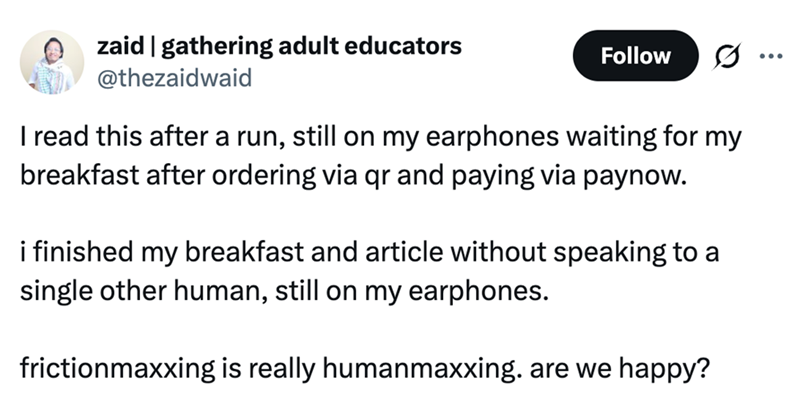
Making one’s life harder on purpose is not an easy idea to sell. Life is full of unpleasantness that can range from irksome to devastating. Why would we opt out of anything that makes those moments a little less painful? It’s about the small things. The core idea behind friction-maxxing is that by learning to tolerate the small inconveniences, we are better prepared to handle the big ones. If you’re used to waiting in lines and talking to strangers and living in the unknown, then you're better equipped for the moments that truly test your patience. It’s the difference between memorizing answers for a standardized test and studying the source material to get a comprehensive understanding of the subject. Memorization might give you an A on the test, but you’re kneecapping your future self who might actually need to access that knowledge.
If we coast through life on cruise control, then we might miss the attractions along the way. In the effort to make everything easier, we may have lost some important details. Going to the grocery store, the local bookstore, or calling up a friend with a question is not useless drudgery. It is an opportunity for us to connect with one another, and in a world full of loneliness, that is essential. Maybe while browsing the produce aisle, you hear a song that you forgot you loved. Maybe the clerk at the bookstore has noticed that you’re really into magical realism and they have the perfect recommendation. Maybe your friend was having a bad day, and their face lit up when you called them. These moments, despite their smallness, are the reason we’re all here on this planet. Technology can sometimes facilitate them, but it’s just as good at taking them away.
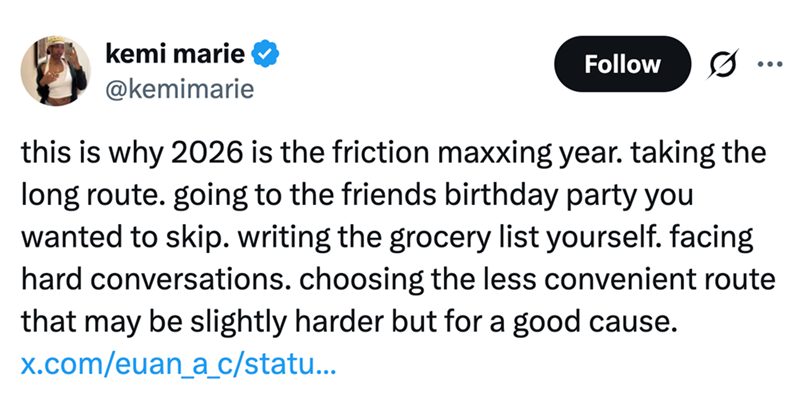
This idea is a powerful counterpoint to most of the messaging we can't help but receive. It encourages us to look at technology skeptically and ask what it really wants from us. Convenience is nice, but it always comes at a price. It's nice to remember that we're in charge of how we use it. We don't have to order our coffee ahead of time on an app, even though it saves us a couple of minutes. We can talk to the barista, get a dose of human interaction, and maybe even learn something. What are we in such a rush for anyway?
Friction-maxxing is only useful where it naturally works for us. We might be okay with cutting back on DoorDash, but we draw the line at Google Maps. There are ways that technology has irrecoverably changed our world, and it feels futile to fight against it. It’s not feasible for everyone to be a technophobe. Sometimes the real world thwarts our best efforts to stay human and insists that we download an app instead. But it’s important to remember that we have agency in the tech that we choose to embrace. At the very least, we can choose not to use it when absolutely necessary. It’s a little rebellion unto itself.